Податотека:Gold nugget (Australia) 4 (16848647509).jpg


_4_(16848647509).jpg)
Опис
| Опис |
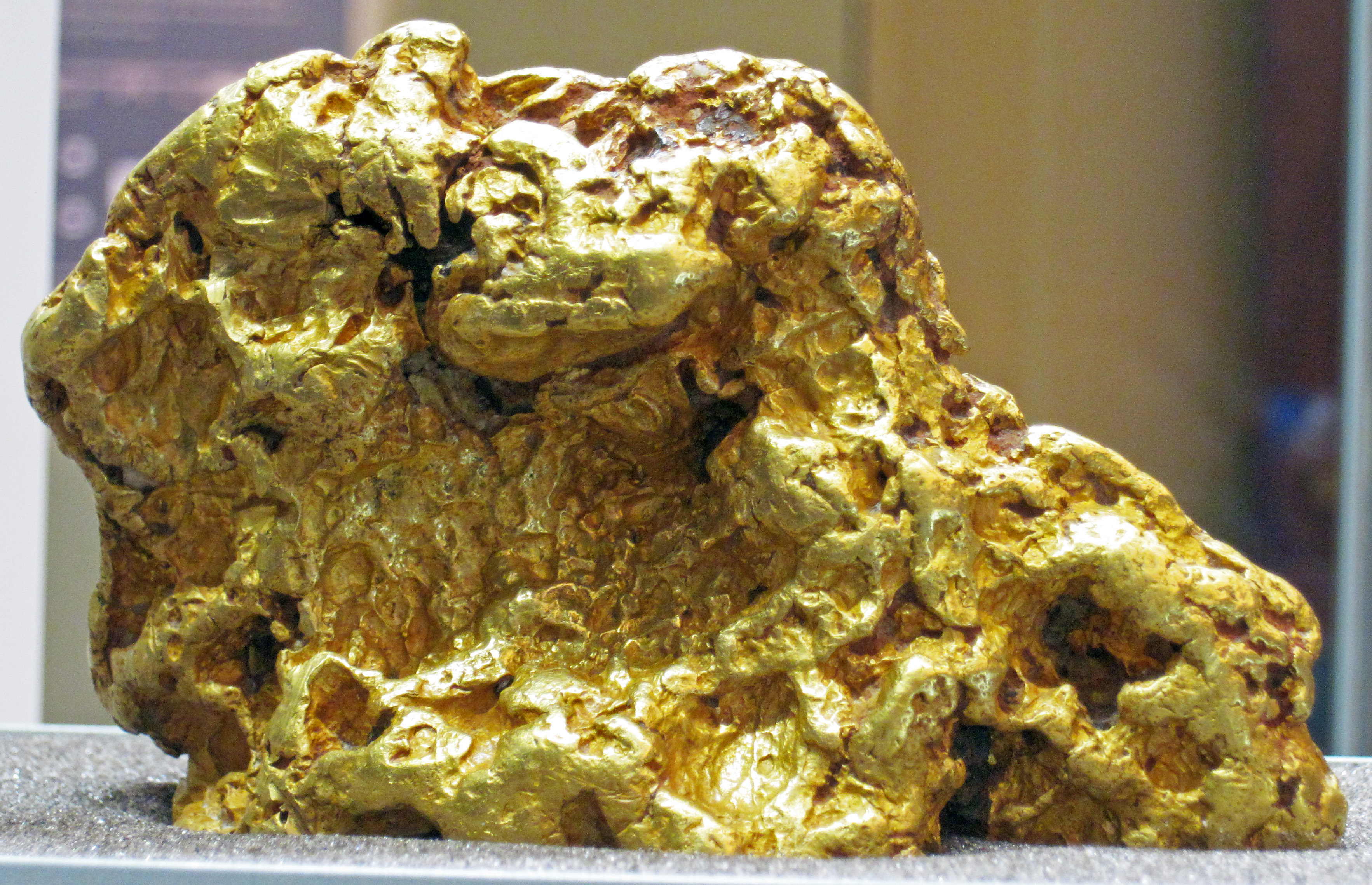
Gold nugget from Australia. (public display, Field Museum of Natural History, Chicago, Illinois, USA). The Australian rock shown above is a large, nearly four pound mass of gold. The irregularly-distributed, smoothly sculpted surfaces indicate that this is likely a fluvial gold cobble - in other words, it appears to be from a placer deposit. Gold is a metal. Metallic, semimetallic (metalloid), and nonmetallic elements are known in their native state as minerals. A mineral is a naturally-occurring, solid, inorganic, crystalline substance having a fairly definite chemical composition and having fairly definite physical properties. At its simplest, a mineral is a naturally-occurring solid chemical. As of the year 2018, there are around 4500 named and described terrestrial minerals - about 200 of them are common and about 20 of them are very common. Mineral classification is based on anion chemistry. Major categories of minerals are: elements, sulfides, oxides, halides, carbonates, sulfates, phosphates, and silicates. Elements are fundamental substances of matter - matter that is composed of the same types of atoms. At present, 118 elements are known. Of these, 94 occur naturally on Earth (hydrogen to plutonium). Gold is a native element in nature. To find a native element, it must be relatively non-reactive and there must be some concentration process. Most of these occur in rocks & minerals, although some occur in very small, trace amounts. Only some elements occur in their native elemental state as minerals. Gold is very rare in crustal rocks - it averages about 5 ppb (parts per billion). Where gold has been concentrated, it occurs as wires, dendritic crystals, twisted sheets, octahedral crystals, and variably-shaped nuggets. It most commonly occurs in hydrothermal quartz veins, disseminated in some contact- & hydrothermal- metamorphic rocks, and in placer deposits. Placers are concentrations of heavy minerals in stream gravels or in cracks on bedrock-floored streams. Gold has a high specific gravity (about 19), so it easily accumulates in placer deposits. Its high density allows prospectors to readily collect placer gold by panning. Gold (Au) is the most prestigious metal known, but it's not the most valuable. Gold is the only metal that has a deep, rich, metallic yellow color. |
| Датум | |
| Извор | https://www.flickr.com/photos/jsjgeology/16848647509/ |
| Автор | James St. John |
Лиценцирање


- Можете:
- да споделите – да го умножувате, распространувате и емитувате делото
- да преработувате – да преработувате
- Под следните услови:
- наведи извор – Ќе мора да дадете прикладен припис, да ставите врска до лиценцата и да укажете дали има направено промени. Ова може да биде направено на било кој разумен начин, но без да оддава впечаток дека лиценцодавецот стои зад Вас и Вашата употреба.

|
Оваа слика е изворно објавена на Flickr од jsj1771 на https://www.flickr.com/photos/47445767@N05/16848647509. Проверена е на 6 април 2015 г. од FlickreviewR и потврдено е дека е лиценцирана според условите на cc-by-2.0. |
Reference
www-acc.esa.int архивски примерок на Wayback Machine European Space Agency 2018
See also
Историја на податотеката
Стиснете на датум/време за да ја видите податотеката како изгледала тогаш.
| Датум/време | Минијатура | Димензии | Корисник | Коментар | |
|---|---|---|---|---|---|
| тековна | 21:35, 6 април 2015 | | 3.531 × 2.278 (2,8 МБ) | wikimediacommons>Jacopo Werther | Transferred from Flickr via Flickr2Commons |
Употреба на податотеката
Податотекава се користи во следнава страница:
_4_(16848647509).jpg)