Податотека:Safe havens for young planets AS 209.tif


Опис
| Опис |
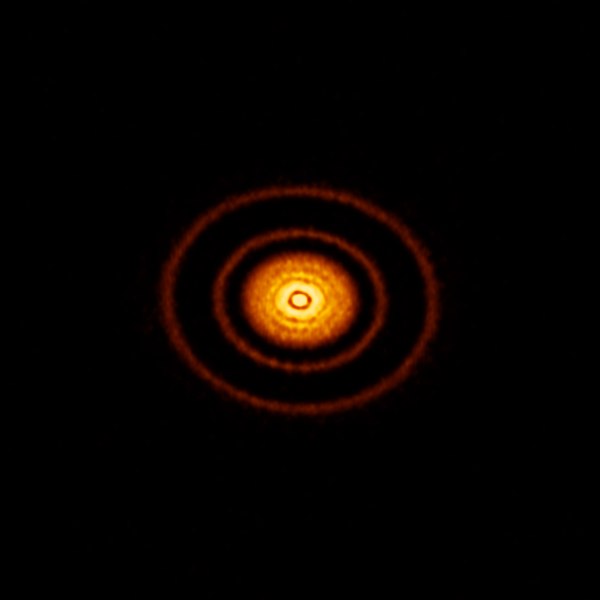
English: This week’s Picture of the Week focuses on one of twenty protoplanetary discs explored and imaged by ALMA’s first Large Program, known as the Disk Substructures at High Angular Resolution Project (DSHARP). The disc is called AS 209, and its substructures are particularly pronounced thanks to its thin, high-contrast rings and almost face-on orientation towards us.
Though concentric rings — shown here in particularly beautiful clarity — are a common substructure among such discs, their widths, separations, and number can vary greatly. It’s still unclear how these substructures form, and how planets emerge from them. Quantifying and studying these similarities and differences was a motivator for constructing ALMA, and was the main objective of DSHARP. These details may hold clues to the type of planetary system that will eventually emerge. One interpretation is that there may be a rapid and complex interplay between young protoplanets and the disc itself far earlier in the evolution of the planetary system than previously thought. A leading theory of planet formation requires dust within these discs to clump into grains, then pebbles, and eventually planetesimals. This theory has always been stumped, however, by the fact that once an object reaches a certain mass, the dynamics of these discs would cause it to be sucked into the host star at the centre, thus halting its growth into a true planet. The results from the DSHARP program suggest that disc substructures may perturb these dynamics and provide safe havens where young planetesimals can continue growing — making the substructures observed here crucial to our own existence. Next week’s picture will be the final instalment in the DSHARP series, and will showcase another of the twenty images: this time a multiple star system. |
| Датум | |
| Извор | https://www.eso.org/public/images/potw1905a/ |
| Автор | ALMA (ESO/NAOJ/NRAO), S. Andrews et al.; NRAO/AUI/NSF, S. Dagnello |
Лиценцирање
_logo.svg) |
This media was created by the European Southern Observatory (ESO).
Their website states: "Unless specifically noted, the images, videos, and music distributed on the public ESO website, along with the texts of press releases, announcements, pictures of the week, blog posts and captions, are licensed under a Creative Commons Attribution 4.0 International License, and may on a non-exclusive basis be reproduced without fee provided the credit is clear and visible." To the uploader: You must provide a link (URL) to the original file and the authorship information if available. |
  Оваа податотека е под лиценцата Криејтив комонс Наведи извор 4.0 Меѓународна.
| |
Историја на податотеката
Стиснете на датум/време за да ја видите податотеката како изгледала тогаш.
| Датум/време | Минијатура | Димензии | Корисник | Коментар | |
|---|---|---|---|---|---|
| тековна | 10:48, 4 февруари 2019 |  | 1.500 × 1.500 (6,47 МБ) | wikimediacommons>Jmencisom | User created page with UploadWizard |
Употреба на податотеката
Податотекава се користи во следнава страница: